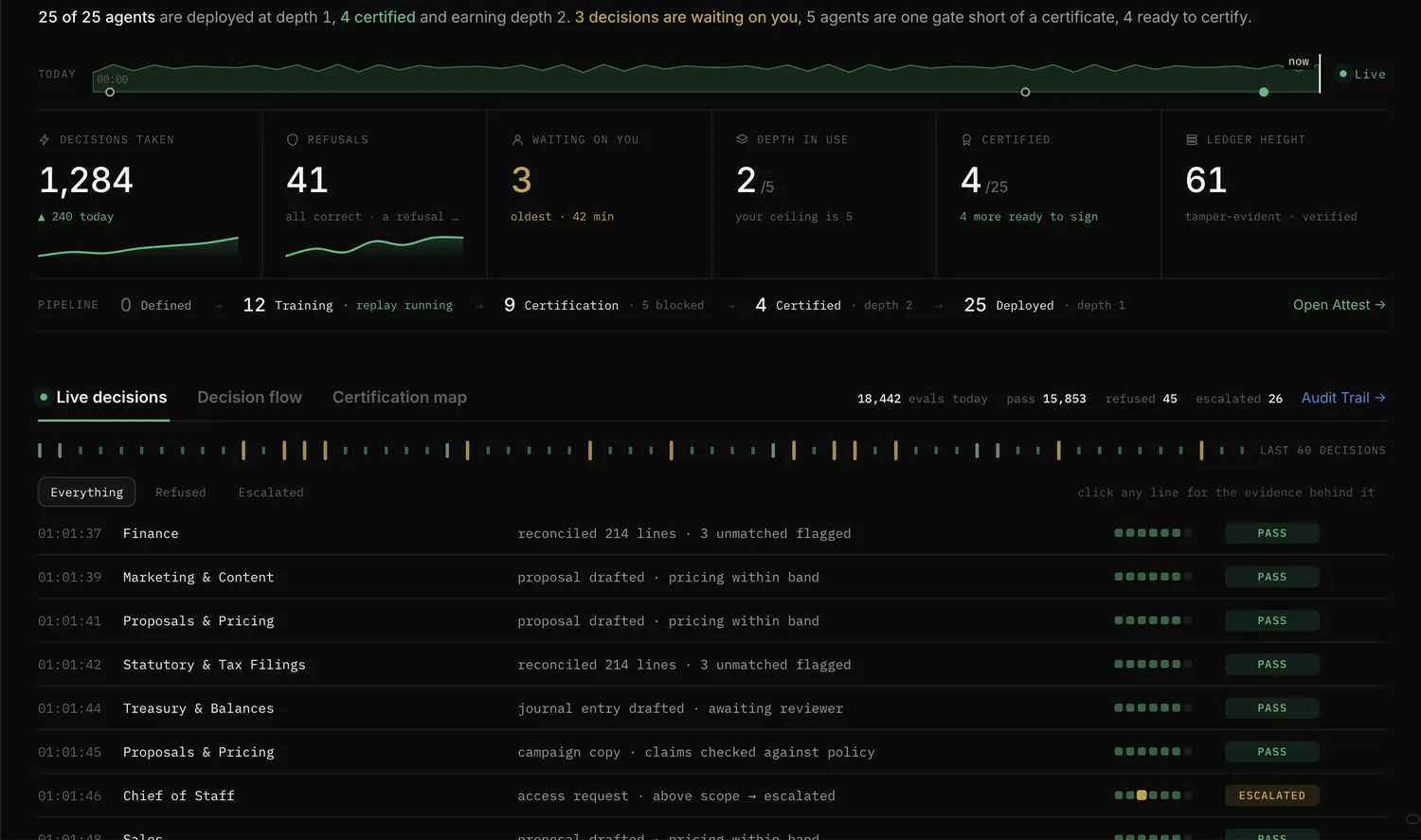
There is a temptation, when you build a governance layer, to show it off only at the dramatic moments. The blocked payment. The withheld reversal. The guardrail catching something ugly on its way out the door. Those make the best screenshots, and they are the ones every demo reaches for.
They are also, by a wide margin, the minority of what happens.
On a normal day the overwhelming majority of agent actions are uneventful. A refund inside the window, under the cap, on a capability the agent is certified for. Every bound allows it, nothing fires, and the customer gets their money. If your governance surface only lights up for the exceptions, then for most of the day it looks like nothing is running at all — and a control that appears to be absent is a control nobody trusts.
What we changed because of this
The first request in our own governance demo is deliberately boring: refund order #4102, £212, allowed, done. It is the first thing we show, not the last. Every bound reads depth 3, no link is highlighted as binding, and the copy says so plainly — nothing binds here.
That last detail took a rewrite to get right. Our first version always highlighted a binding link, because the code took the minimum and marked whichever bound produced it. On an allowed action that meant arbitrarily lighting up one of five identical values, which quietly invented a constraint that had not applied. The fix was small and the principle behind it is not: when nothing decided, show that nothing decided.
A system that only speaks when it refuses has taught you to read its silence as absence. It should read as approval.
What the boring cases are actually forThe evaluation stream
The same reasoning drives the live stream on the workspace overview. It shows every evaluation — passes at 0.97 and 0.98, gates going to review, the occasional flag at 0.53 — rather than filtering to the interesting ones. It is mostly a wall of passes, and that is the point. The governance score above it is recomputed from that stream rather than entered by anyone, so what you are watching is the thing that produced the number.
There is a cost. A screen that shows everything is harder to design than one that shows exceptions, and considerably harder to keep legible at volume. We have rebuilt the human review queue twice for this reason, because fourteen items and four hundred items want different layouts and only one of them is the demo.
But the alternative is a product that performs governance rather than doing it — visible exactly when it is least needed, and invisible during the thousands of actions where being correct actually mattered.