Evidence first
Generic AI platforms ask you to trust the model. Pryme Intelligence asks you to trust the evidence.
Every prompt, every tool call, every reviewer decision — captured server-side, encrypted, region-scoped, and ready for your auditor before you ship.
Pryme Intelligence is built for the buyer whose regulator will read the logs. Controls, residency, identity, and governance are not features bolted on. They are the substrate every agent runs on.
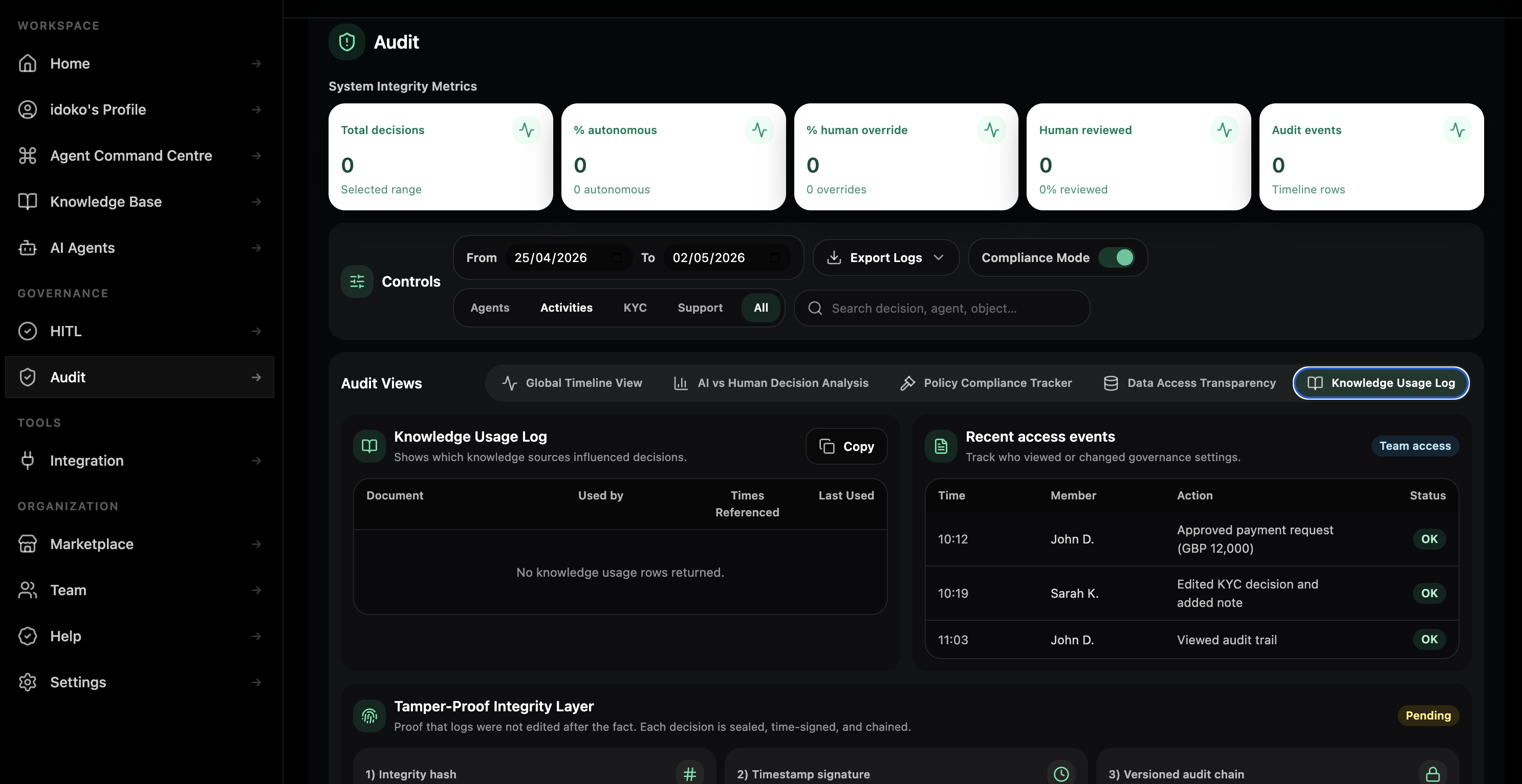
Generic AI platforms ask you to trust the model. Pryme Intelligence asks you to trust the evidence. Every agent runs inside a governance rail that records what was asked, what was retrieved, what was decided, and who approved it before any output reaches a customer, colleague, or regulator.
That foundation lets Pryme Intelligence deploy into regulated environments without asking buyers to lower their standards. The same rail protects a 12-person fintech and a national-scale public service team. There is no separate enterprise trust tier.
Generic AI platforms ask you to trust the model. Pryme Intelligence asks you to trust the evidence.
There is no separate enterprise trust tier. Every customer gets the full governance rail from day one.
The buyer who signs off on Pryme Intelligence can defend the choice to a CISO, auditor, regulator, or internal review board.
Encrypt everything. Isolate everything. Keep data where you said it would be.
Every action passes through the governance rail before it ships.
Server-authored audit trail. Immutable. Replayable. Exportable.
Detect fast. Contain faster. Communicate honestly.
The governance rail sits between the model and the world. Nothing skips it. No debug path, no admin bypass, no unlogged side door.
Every interaction is decomposed into stages, each with its own enforcement point and evidence capture. Most platforms log the response. Pryme Intelligence logs the chain. That is the difference between “the agent said X” and “here is the full reasoning, retrieval, policy, and approval path that produced X.”
Request is normalised, source is verified, session is mapped, and authentication is confirmed before anything runs.
PII, prompt-injection, jurisdictional checks, and other classifiers run before the request proceeds.
Only knowledge bases the user is entitled to are queried, and the retrieval scope is logged chunk by chunk.
Every tool call is checked against the agent permission set before execution; high-impact actions can require a reviewer signature.
Model version, system prompt, parameters, and full context are captured before any post-processing happens.
Outputs are screened for hallucination, banned content, and fact-class violations before delivery.
If the certification state or policy requires it, a named human reviewer must approve before delivery.
The final output is delivered to the surface and the full chain is sealed as one immutable record.
The audit trail is authored on the server, not the client. The same record is visible to your reviewer in the Workspace, your SIEM team in their tool, and your auditor in an export.
Replay any historical interaction with the original context, model version, and policy state.
Export continuously to Splunk, Sentinel, Datadog, Elastic, or a generic SIEM feed.
Retention can be configured by workspace policy, with machine-readable export on demand.
Chain-of-custody is designed to make tampering detectable rather than merely discouraged.
Authenticated user, agent, deployment surface, session, IP, and device fingerprint.
Prompt as received, system prompt as active, model version, parameters, and policy state.
Every knowledge chunk surfaced, its source document, version, and entitlement check.
Every tool invoked, the parameters passed, the response received, and the authorisation that allowed it.
Raw model output before post-processing, with token counts and latency.
Every gate the request passed through, what it evaluated, and what it decided.
Reviewer identity, decision, timestamp, rationale, and any edits or redactions made.
Where the output landed, who received it, and confirmation that it shipped.
Residency is part of the operating model, not a loose preference. The rule is simple: data stays inside the region and boundary you approved.
Default residency is the region you choose at workspace creation, and customer data stays inside that region.
Available regions include the United States, European Union, United Kingdom, Australia, and Canada.
Sovereign deployment runs Pryme Intelligence inside customer-controlled environments for higher-classification workloads.
We do not move customer data across regions for capacity or operational convenience.
Customer prompts, knowledge bases, retrievals, and outputs are never used to train Pryme Intelligence or upstream models.
The point of the Trust Portal is simple: put the evidence one click away so security review moves in days, not weeks.
SOC 2, ISO certificates, pen-test summary, and current attestation documents in one place.
Privacy policy, DPA, BAA template, sub-processor list, incident response summary, and disclosure policy.
CAIQ, SIG Lite, SIG Core, and VSAQ answers prepared and dated for security teams.
NIST CSF, NIST AI RMF, ISO 27002, CIS Controls, and EU AI Act documentation pack.
Data flow, deployment topology, and key-management views suitable for internal review boards.
Live operational status, sub-processor locations, certifications, and change-notification process.
Whether you’re a 12-person fintech or a sovereign agency, you get the same governance rail, the same audit trail, the same residency commitments, and the same trust posture.
If you’d rather we just answer your questionnaire, send it to security@prymeintelligence.com. Most come back inside 48 hours.
No. Customer prompts, knowledge bases, retrievals, and outputs are never used to train base models, fine-tune models for other customers, or improve general platform behaviour. Training you initiate inside your own tenant stays inside your tenant.
In the region you select at workspace creation, and only that region. We do not move data across regions for capacity, latency, or operational convenience. Higher-classification workloads can run through sovereign deployment inside your own environment.
Every prompt, retrieval, tool call, model response, policy decision, and reviewer action is captured server-side, cryptographically chained, and exportable. You can replay historical interactions with the original context, model version, and policy state when audit or incident review requires it.
SOC 2 Type II, ISO/IEC 27001, and ISO/IEC 27701 are positioned as live in the trust programme. The page also reflects aligned and in-progress work across GDPR, HIPAA readiness, PCI alignment, the EU AI Act, and NIST AI RMF mappings.
Customer-managed keys are handled through the enterprise architecture review path, alongside dedicated-environment and sovereign deployment requirements.
The operating-rule commitment on this page is notification within 24 hours of confirmed material incident, with follow-on incident reporting after containment and root-cause analysis.
Reviewer gates insert a named human checkpoint into the rail before output is delivered. Reviewers see the context, retrieved sources, proposed output, and policy decisions, then approve, edit, or reject. That decision is captured in the audit trail.
Yes. Sovereign deployment is the path for customer-controlled environments, including private cloud accounts and higher-assurance isolated environments.
The trust posture on this page includes exportability, configurable retention, and defined deletion workflows so customers can leave without data hostage problems.
Open the Trust Portal or send the questionnaire to security@prymeintelligence.com. The page is designed so the evidence pack, control mappings, and standard questionnaire responses are already prepared.